Virtual reality for Pain Reduction, HypnoVR
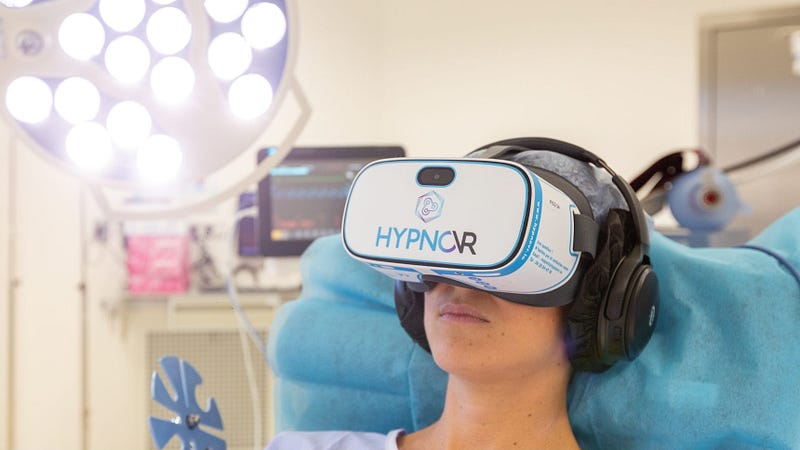 Photography from HypnoVR
Founded in 2016 by two anesthesiologists and hypno practitioners, Hypno VR is a Strasbourg-based startup that aims to reduce pain and anxiety before, during or after a medical procedure through virtual reality.
Their technology could reduce pain and the use of anxiolytics by half and make post-op stays 3.5 times shorter.
The technology
Since its strong gain in popularity in 2015, the VR market has mobilized many players, including those in the medical industry. Companies, such as Proprio or Immersive Touch, offer new solutions for assisting or training surgeons. As for Hypno VR, they are more interested in the patient than in the surgeon. They propose a new solution to reduce pain and anxiety in the medical world.
HypnoVR uses virtual reality headsets — such as the Pico G2, Samsung Gear VR, Oculus GO or Oculus Rift — to provide 6 audio and video universes allowing to reduce the perception of pain, but also stress and anxiety. Each universe is captivating and relaxing. You can feel yourself in the middle of a snowy forest, on a paradisiacal beach, in the middle of a tropical ocean or even in space. Each universe is made up of 22 scenarios integrating sequences of guided breathing, cardiac coherence and “hypnotic suggestions”. All of this can be controlled via a tablet or a smartphone beforehand.
The device can be used throughout medical care (pre-operation, operation, post-operation) and for various applications: Anesthesia and intensive care; Surgery; Dental care; or Imaging.
Since the implementation of its device, HypnoVR has conducted 13 clinical studies and is currently conducting 15 others. They present very interesting results: 41% reduction in chronic pain, 23% reduction in respiratory rate, 0 negative impact of the device on visual fatigue and brain alertness. After scoliosis surgery in children, the use of the helmet would allow a 45% reduction in opioid consumption, a 63% reduction in anxiolytic consumption, and a 40% reduction in post-operative pain.
HypnoVR has obtained the class 1 medical device, as well as the ISO 13485 standard which specifies the requirements for a quality management system for medical devices.
Fundraising
The team, which currently consists of 27 people, raised €4.5 million in Series A on December 7.
This round of financing was made up of the Belgian funds Theodorus and Akiles, the Banque des Territoires on behalf of the State as part of the future investment program (PIA) “Territoires d’innovation” of Capital Grand Est and Bpifrance. The historical investors (Guillaume Richard, founder of OuiCare and the family office of Daniel Caille, CEO of Vivalto Santé) also participated in this fundraising.
The company had already raised 700,000 euros in 2018 and 1.7 million in 2020.
Business Model
HypnoVR offers multiple ways to enjoy its products:
- A software through monthly subscriptions depending on the number of headsets used (first subscription at €149/month);
- Direct sale of virtual reality headsets, audio headsets, and branded storage cases.
The company also provides purchasers of the device with training through tutorials and remote support.
Clients & Partners
HypnoVR is intended for healthcare professionals, particularly those specialized in anesthesia and surgery. 240 European institutions (about 85% of which are French) are already equipped with this technology, which they have used on 40,000 patients.
The startup’s partners include Pierre Fabre Group, Braun, and EIT Health (European Institute of Innovation and Technology).
Market
The company is positioned as a digital therapy (DTx).
The global market for digital therapies or DTx could approach $7 billion by 2025, according to a PitchBook report published in September 2020. According to Juniper Research, the market for digital therapies is expected to exceed $32 billion by 2024.
Currently, in metropolitan France, there are 3008 healthcare establishments with full or partial hospitalization capacity, including 1,354 public hospitals, 983 private clinics, and 671 private not-for-profit establishments. In 2019, 12.9 million patients were hospitalized one or more times.
Focusing on surgical activity, there were 7,417 surgical rooms in 965 healthcare facilities for 5.8 million surgical stays in 2019.
Competitors
More and more companies are proposing the use of VR in medicine, but most focus on devices that are useful to physicians and not to patients. With the same model as HypnoVR, there are a few companies, among which :
- Healthy Mind — Therapeutic Virtual Reality (created in 2017) ;
- Digital Sedation™ (oncomfort.com) (created in 2017).
The business part of this article was written by Emilie Nouacer, the tech part by Mathieu Van de catsije.