The Social Capital of Opinion Leaders
Contents
 Photo by Jehyun Sung on Unsplash
The first responsibility of a leader is to define reality. The last is to say thank you. Between the two, the leader is a servant. Max De Pree
Opinion leaders, or network entrepreneurs
In The Social Capital of Opinion Leaders, Ronald S. Burt is concerned with the striking resemblance of opinion leaders to the “network entrepreneurs” of social capital research.
This comparison is based on an interesting vision of opinion leaders, encouraging us to see these people not as conventional leaders but rather as opinion brokers. Using this “modern” view of opinion leaders allows Burt to make a strong comparison with “network entrepreneurs”.
Burt does the work in his article of explaining these two concepts, the research on the network structure of interpersonal contagion and the research on the network structure of social capital, through landmark studies, and finally explains how these two personas can be so similar.
Bureau of Applied Social Research
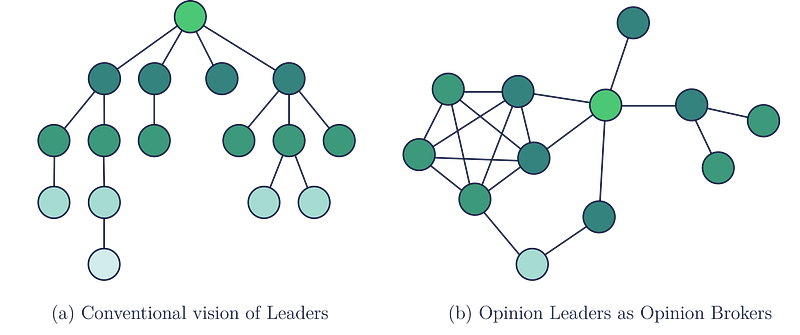 Distinction between the conventional vision of Leaders and the vision introduced by the BASR
The idea that opinion leaders are primarily transmitters of opinion was developed in the 1950s by the Bureau of Applied Social Research at Columbia University. This was followed by a flurry of very interesting studies on the important role of opinion leaders in the propagation of innovation and opinions. Leaders are no longer seen as tidy heads of rank, but rather as bridges between social groups enabling the transmission of opinions, as illustrated in Figure 1, above.
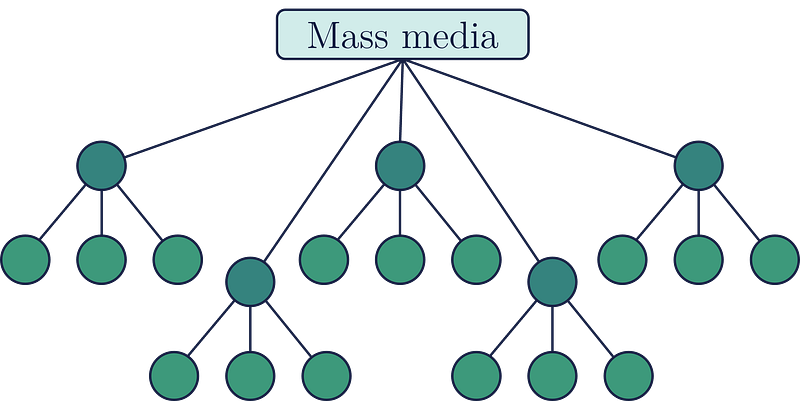 Result of The People’s Choice by Lazarsfeld, Berelson, & Gaudet
One landmark story is the 1944 study by Lazarsfeld, Berelson, and Gaudet, entitled The People’s Choice. This project studied the human interactions leading to the results of the 1940 U.S. presidential election. While one might have expected the media to have a direct influence on the population, the study shows something quite impressive: opinion leaders are the real transmitters of information. Thus it was found that ideas often flowed from radio and print media to opinion leaders and from them to less active sections of the population.
Social capital
On the other side of the comparison are the “network entrepreneurs” described by social capital theory.
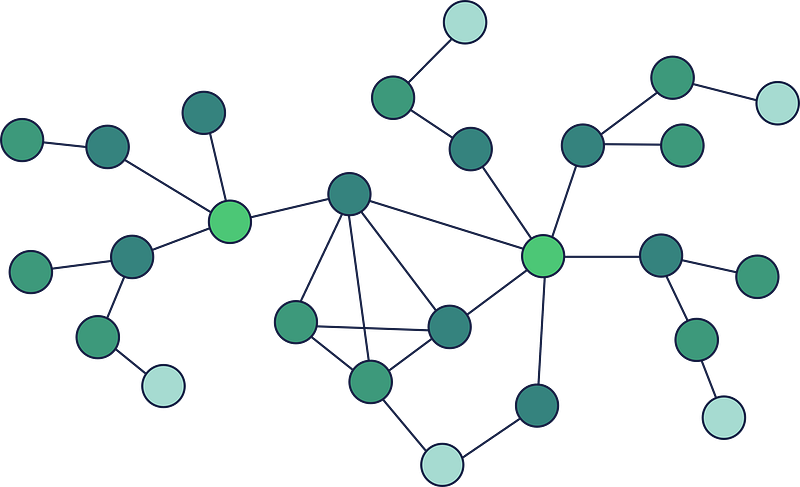 Social Capital Theory illustrates
Social capital refers to the ability to mobilize resources through one or more social networks. A person with strong social capital is, therefore, a person with strong social ties giving him/her access to many resources of all kinds. In a very popularized way, the social capital theory explains “that the most successful people are better connected.”
What Burt describes as network entrepreneurs are people who enjoy a privileged position. Thus, they are network entrepreneurs in the sense that they “leverage” their networks to grow.
In the same way that leaders are ultimately described as brokers enabling the connection between different people. Network entrepreneurs often act as bridges between different structural holes or holes in structures.
If, for example, we take Figure 3, we observe that the light green dots have very high social capital, while the light blue dots have low social capital. It will undoubtedly be easier for the points with high capital to undertake, as their resources are greater.
Methodology
To support his points, Burt looks at the description of several research studies.
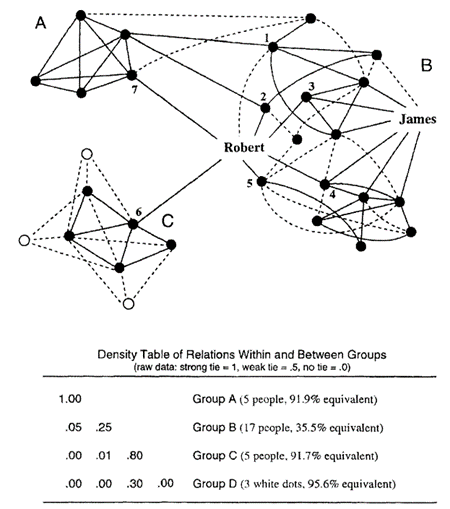 Network introduced in The Social Capital of Opinion Leaders
The first part describes the plausible equivalence between opinion leaders and opinion brokers. Burt presents a fictitious network to show the extent to which opinion leaders serve as transmitters of information in a network. Burt discerns two very important variables in the transmission of information: cohesion, which refers to the strength of the relationship between the ego (the receiver) and the alter (the sender); equivalence, which refers to the fact that egos and alters have similar relationships with other people.
Three studies are then presented to illustrate the links between opinion leaders and opinion brokers through practical cases. The first one shows a network of doctors and the transmission of innovation through the network: the speed at which a doctor adopts a new treatment based on the recommendation of his peers, but not only. A second study looks at how donation managers are inspired (or not) by others to rate the charities to which they direct donations. Finally, the last study describes the social system of elite lobbyists active in U.S. government policy in the early 1980s.
In a second step, Burt describes the network structure of social capital. He again draws on Figure 4 (above) to explain the utility of Robert’s or James’ positions.
The complete and oriented description of these two concepts allows Burt to conclude on the “striking” similarity of opinion leaders to network entrepreneurs.
Results
Opinion leaders as opinion brokers
According to Burt, opinion leaders are ultimately brokers or carriers of the information who act as bridges between different groups.
Opinion leadership consists of influence exerted through strong relationships (cohesion) between weakly equivalent people (similar relationships with other people).
The utility of network entrepreneurs
Network entrepreneurs are people who make use of their position as transmitters in a network. They are well placed, exchange with diverse groups, and thus have a privileged position in the network.
Thus, network entrepreneurs are people who add value by connecting with others. The more diverse their network, the more benefits (or profit if you’re more cynical) they can get.
Opinion leaders and network entrepreneurs
Opinion leaders, therefore, seem in many ways equivalent to network entrepreneurs. They both act as bridges between different groups, taking advantage of the diversity of the groups and their connections.
The difference or rather a complementarity comes however from the way of describing the benefits perceived by these two personas. While diffusion research, with its opinion leaders, describes the substantial details of the intermediation of people in the flow of information between groups, social capital research describes the resulting competitive advantage.
Limits
While very interesting and rewarding, The Social Capital of Opinion Leaders seems to have some limitations.
Burt’s position is oriented from a very “economic” point of view. The opinion leader is seen as a transmitter of information and innovation (more cynically, as a mass manipulator) who profits from his or her position and seems to have a vested interest in working to expand his or her network. Although one can easily adhere to this vision, it would be interesting to look at the other aspects of information transmission, more human and less commercial. This could also tend to question the complementary aspect of opinion leaders and network entrepreneurs. Indeed, with the idea in mind that an opinion leader does not take advantage of the situation but makes others take advantage of it, it would be more coherent to say that the network entrepreneur differs from the opinion leader. Although one does not prevent the other (to benefit others but also oneself).
Another “criticizable” aspect is the unconditional support for the theory of social capital. One could, for example, oppose it or add the theory of human capital and thus include a broader aspect.
From a more subjective point of view, one may find the article rather cynical. It places the opinion leader as a person who profits from his or her situation. The term “profit” can itself carry a negative aspect. While some (including myself) might think that the role of a leader is not to profit, but to connect without even being noticed.
A leader is best when people barely know he exists, when his work is done, his aim fulfilled, they will say: we did it ourselves. Lao Tzu