The history of Nuclear Fission
Critical issue of the 21st century, Nuclear Fission is at the heart of many heated conversations. Once a source of carbon-free energy, then a “destructor of worlds”, yet initially but a prodigious discovery of science; we probably haven’t finished hearing about it. However, despite its strong presence in public and private debate, fission remains a technology that eludes the grasp of many. Linchpin of our future energy system or latent explosive waiting to explode?
Let’s embark together on the journey of unraveling the mystery of nuclear fission, starting with the first chapter that delves into its discovery.
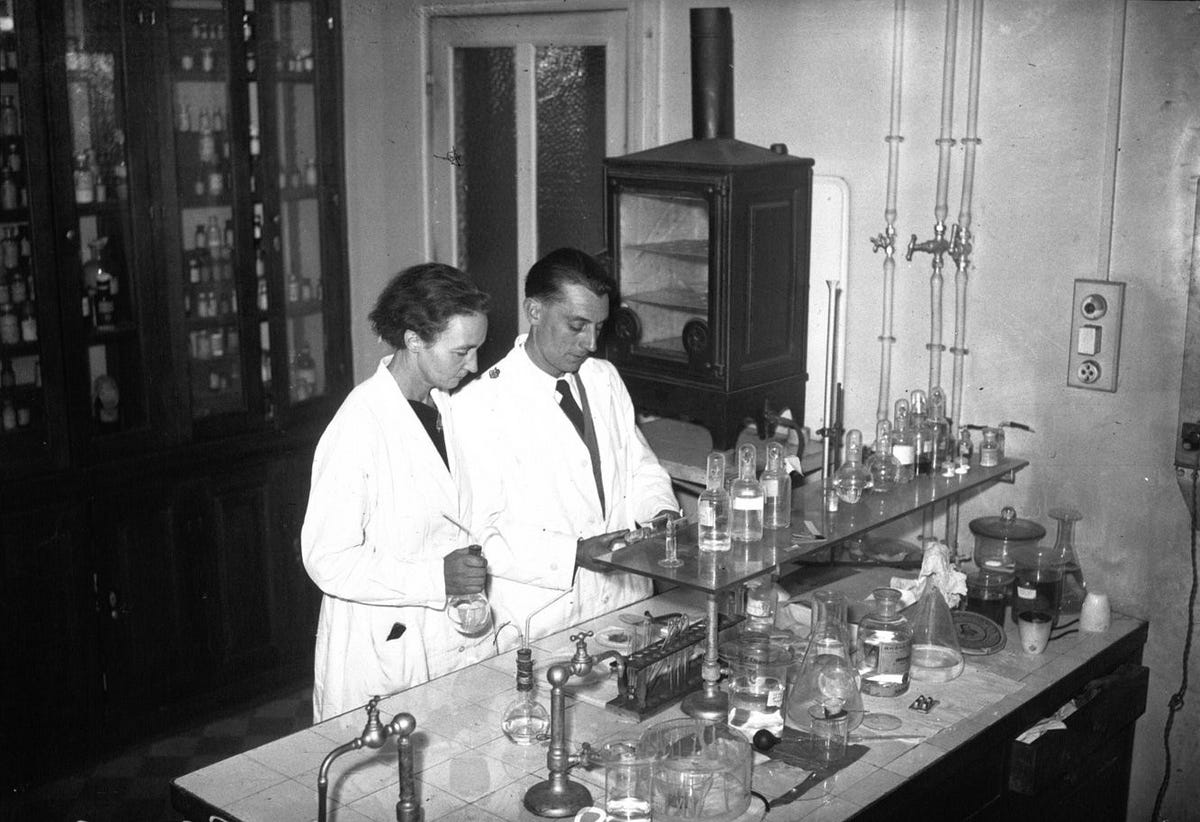 Irène and Frédéric Joliot-Curie in their laboratory in 1935. Agence de presse Meurisse, Public domain, via Wikimedia Commons
The Atom, O. Frisch, L. Meitner & O. Hahn: the Genesis of Nuclear Fission
Let me take you back to the early 20th century, a time of great scientific discovery. It was during this period that scientists began unraveling the mysteries of the atom. Through groundbreaking experiments and research, they discovered that atoms were not indivisible, as previously believed, but were made up of even smaller particles, such as protons, neutrons, and electrons. This newfound knowledge set the stage for the incredible story of nuclear fission, a process that would change the world forever.
Then, in 1932, the neutron’s discovery offered physicists an ideal tool to investigate the atomic nucleus — the center of the atom. Intrigued by the potential, Enrico Fermi initiated uranium bombardment experiments as early as 1934. While many scientists, including Fermi, initially anticipated that this venture would yield heavier atoms, a dissenting voice emerged. Ida Noddack, a German chemist, pointed out that Fermi’s experiment could potentially break up the Uranium atom into smaller elements. History eventually confirmed her foresight, although her contributions remained largely unrecognized.
Inspired by Fermi’s groundbreaking research, Lise Meitner, Otto Hahn, and Fritz Strassmann embarked on their own investigations by bombarding uranium with neutrons and closely monitoring the resulting decay products. Lise Meitner, of Jewish heritage, is tragically compelled to flee Germany, leaving behind her pioneering work. However, Hahn and Strassmann remained in Germany and persevered with their experiments.
In December 1938, these two chemists made a remarkable discovery: the bombardment appeared to yield an atom smaller than the initial one. This perplexing observation contradicted the prevailing belief that a tiny neutron couldn’t possibly induce a nucleus to fracture.
Upon learning of this discovery, Meitner embarked on a quest to unravel this new enigma, and she was soon joined by her exceptionally talented physicist nephew, Otto Frisch. Their quest for understanding led them on a stroll, during which Meitner proposed a concept that remains one of the most effective explanations for fission to this day.
The idea was elegantly simple: envision the atom as a water droplet. When a neutron strikes the atom, the water droplet (representing the atom) elongates and then constricts at its center, ultimately splitting into two smaller drops. What a brilliant mind!
 Nuclear Fission imagined by Meitner. Stefan-Xp, CC BY-SA 3.0, via Wikimedia Commons
When the atom split, the two resulting droplets naturally moved away from each other because they strongly pushed each other away and had a lot of energy. But there’s a fundamental rule in physics: things can’t appear or disappear out of thin air, and movement requires energy. So, for the atom to split and for the parts to move apart, they needed extra energy. Without this energy, they would remain stationary.
Lise Meitner’s clever solution was that the atom didn’t split neatly into two perfect droplets. Instead, some of the original atom seemed to vanish. In physics, nothing can magically appear or disappear. So, the missing part transformed into energy, giving the two droplets the push they needed to move apart.
Three months later, in March 1939, within the prestigious scientific publication Nature, Meitner and Frisch unveiled a concise one-page article titled “Products of the Fission of the Uranium Nucleus.” This seminal publication marked the dawning of a new era: the age of Nuclear Fission.
Subsequent to this groundbreaking release, scientists worldwide, including the illustrious Curies in Paris and Enrico Fermi at Columbia University, diligently replicated and extended their work. Their collective efforts yielded pivotal discoveries, most notably the revelation of the chain reaction, which would eventually underpin the design of nuclear power plants. However, this progress also carried with it the ominous shadow of the atomic bomb, destined to be remembered as a world-altering and destructive force.
Remarkably, Meitner declined involvement in the Manhattan Project, which focused on atomic weaponry. Instead, she persisted in her research on fission and made significant contributions to the establishment of Sweden’s inaugural Nuclear Power plant.
While Otto Hahn and Fritz Strassmann received recognition as the discoverers of nuclear fission, with Hahn being awarded the Nobel Prize in Chemistry in 1944, Meitner’s extraordinary contributions remained largely unacknowledged until relatively recently.
What an extraordinary period it must have been for science! Numerous brilliant minds collaboratively pushed the boundaries of human knowledge, yet at times found themselves in opposition as they delved into the intricate, formidable, and, at times, disconcerting realm of Nuclear Fission. Isn’t science simply captivating?
In the upcoming chapter, we will delve into the process of fission itself: how do we harness such a momentous discovery, both for the betterment of humanity and, regrettably, for horrible purposes?
Find out next week in Comprendre by subscribing.
This article was initially published on the Comprendre newsletter and blog. Check out the blog right here.