Powering the Future: The Critical Role of Batteries in the Electric Revolution
This article was written for the Comprendre newsletter: subscribe to get the next article and more!
About a year ago, the European Commission voted for an agreement ensuring all new cars and vans registered in Europe will be zero-emission by 2035. In the past seven years, electric car sales worldwide have increased more than tenfold.
The growing concern over fossil fuels and their impact on climate change is undeniable. In response, many countries and consumers are turning to electric systems, seen as greener and more sustainable. However, like any technology, electric systems have their own set of concerns.
Scientists are debating the efficiency of renewable energy sources and the risks associated with nuclear power. One aspect, however, seems non-negotiable: the increasing importance of batteries.
Batteries have been integral to our lives for decades, powering everything from phones and computers to cars and gaming consoles. With the rise of electric vehicles and devices, batteries face new challenges. We need them to be more efficient, so our electric cars don’t stop midway. They must last longer, reducing the frequency of phone replacements. Most importantly, we need more batteries!
So, what are these indispensable batteries? How do they work? And how will they facilitate the electrical transition?
Let’s explore together the interesting world of battery!
How Batteries Work
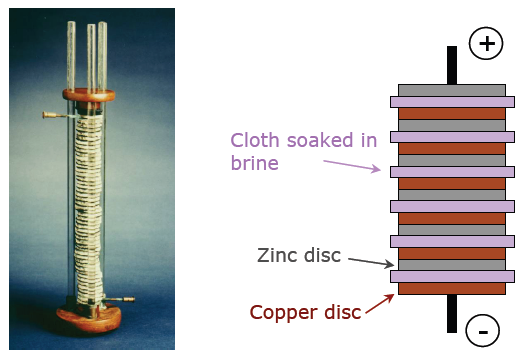
Contrary to popular belief, the concept of the battery is not a modern invention but dates back over 200 years. In the 1780s, a debate between two Italian scientists, Luigi Galvani and Alessandro Volta, led to the invention of the voltaic pile, the first electric battery. However, it was British scientist Michael Faraday who later unraveled the mystery of this device.
The voltaic pile was a stack of copper and zinc discs separated by cloth soaked in saltwater. This setup produced a consistent electric current, which Faraday explained in 1834 as the result of a chemical reaction called oxidation.
Zinc do not have a very stable atomic structure, therefore it has a tendency to loose some of its electron if it is surrounded by other atoms with a stronger pull. This phenomenon is called the oxydation, a reaction during which an atom loose one or more of its electron.
Next to a piece of copper, the Zinc would oxidize and transfer its electron to the copper. This transfer create an electrical current — a movement of electrons.
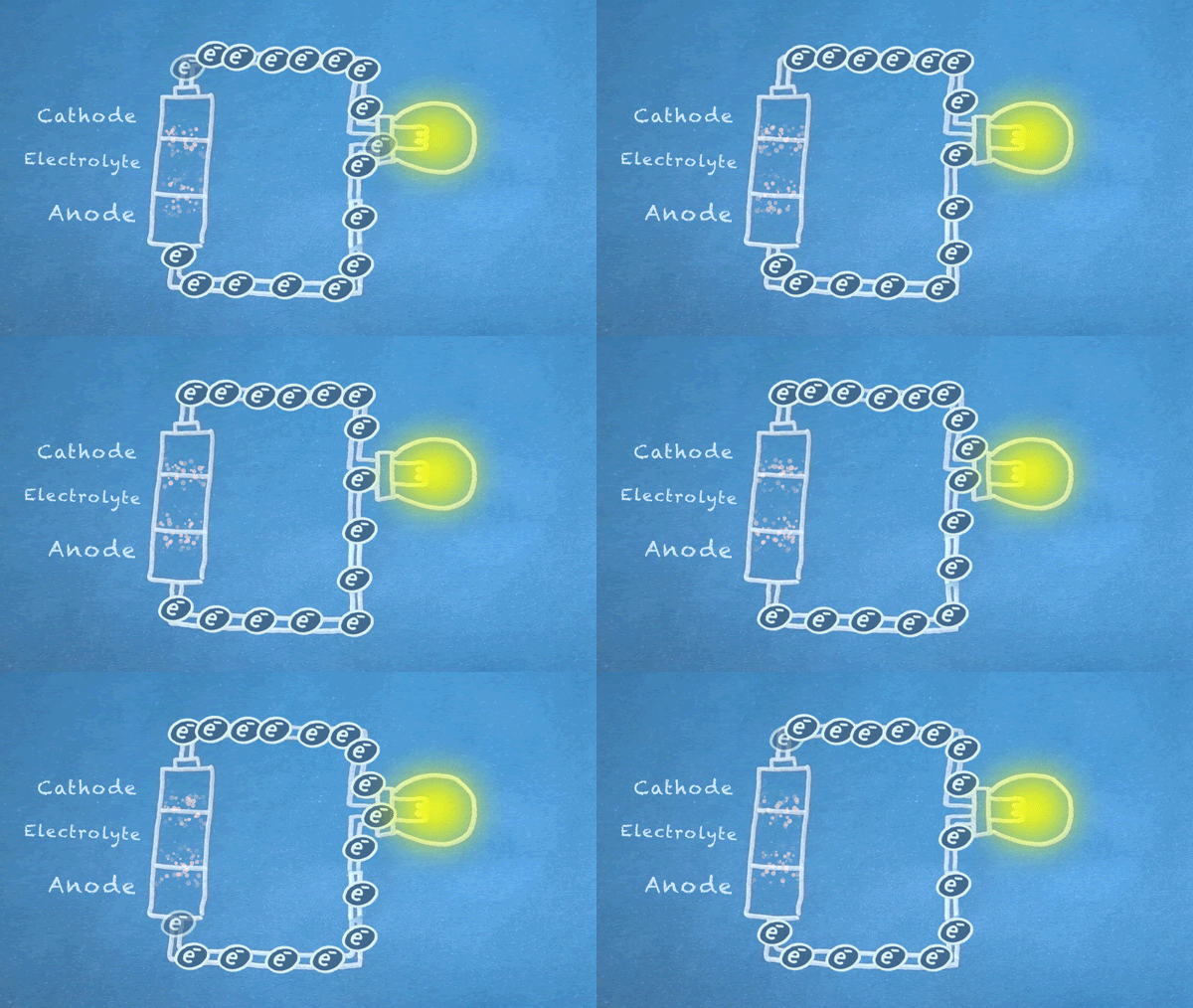
Modern batteries are more powerful and complex than Volta’s invention, but they still rely on similar chemical reactions and structures. The anode (negative side) of a battery, due to oxidation, loses electrons, which then move to the cathode (positive side), generating an electric current.
Understand the process with this TED-Ed video.
The Lithium Battery
Let’s take the example of the famous Lithium battery commonly used in electric cars. Note that to provide an easier explanation we examine the Lithium Cobalt battery, today Lithium battery mostly use other process, with less ores requirement (see Robert Roth comment on this article). It consists of:
- An anode made of small intercalation of Lithium and Carbon Graphite’s layers, is the part that will oxidate therefore releasing electrons.
- A cathode composed of a mix of cobalt and oxygen called cobalt dioxyde, is the part that will receive electrons.
- An electrolyte composed of organic material will allow the general stability of the process.
- A separator preventing direct contact between the anode and cathode while allowing ion flow.
When a battery discharges, lithium atoms at the anode release electrons, transforming into lithium ions. These ions, essentially lithium atoms with an imbalance of electrons, migrate through the electrolyte and the separator towards the cathode. Concurrently, the electrons relinquished by the lithium atoms travel through the external circuit, supplying the electrical power needed to operate a device. Upon reaching the cathode, these electrons reunite with the lithium ions and the cobalt dioxide, completing the circuit.
During the recharge process, an external power source imposes a voltage across the anode and cathode that exceeds the battery’s own voltage. This higher voltage prompts lithium ions to reverse their journey, moving back through the electrolyte and separator to the anode. Simultaneously, electrons flow through the external circuit to the anode. Here, the lithium ions and electrons come together again, restoring the battery to a state where it can be discharged once more.
Take a look at this incredible video explaining the work of a Lithium battery!
The Challenges
 Some 20,000 people work at Shabara artisanal mine in the DRC, 5,000 at a time. Junior Kannah /AFP via Getty Images
If you have been using the same phone for a while, you have probably realized by now that the older your phone gets the worse its battery life becomes. This isn’t due to some trick played by the phone manufacturer, but to a degradation of the ores in the battery (like the lithium) after the repetition of multiple oxidation (discharge) and reduction (recharge).
As batteries age, their efficiency declines due to chemical degradation. This degradation can lead to issues like reduced conductivity and, in the worst cases, short circuits.
Researchers are working on finding better materials and improving battery life. However, this leads to another challenge: batteries require finite resources like ores, often extracted under ecologically and humanitarianly questionable conditions.
Lithium batteries, for instance, not only require lithium but also cobalt. Approximately 70% of the world’s cobalt is sourced from the Democratic Republic of the Congo, where mining conditions are often dire. Many NGOs liken these conditions to slavery. Siddharth Kara, a professor, author, and researcher focusing on modern slavery, describes the situation vividly: “Imagine an entire population unable to survive without scavenging in hazardous conditions for a mere dollar or two a day. In these regions, the mines dominate every aspect of life.”
However, even if we manage to improve mining conditions globally and adopt more sustainable practices, the soaring demand for these ores presents a significant challenge. This increased demand inevitably leads to intensified extraction efforts, a pace we may struggle to sustain. Some studies indicate that under current European transition plans, lithium production would need to increase twenty-onefold by 2050. Such a demand raises concerns about the Earth’s capacity to support this level of resource extraction, highlighting the need for more sustainable and ethical approaches in our shift to electric technologies.
Looking Ahead
Waving our goodbye to fossil fuels and transitioning to a greener electric world, might not be as easy as initially imagined. Batteries, essential to this transition, are remarkable scientific achievements but come with significant costs.
With ongoing research into more efficient batteries, improved mining practices, and advocacy for better treatment of miners, there is hope for a more sustainable future. In the meantime, we can make conscious choices, support sustainable practices, and advocate for policies that protect workers and the environment. Our collective efforts can lead to meaningful change as we navigate the challenges and potentials of this transition.
This article was written for the Comprendre newsletter: subscribe to get the next article and more!