Metaverse, what is it?
Contents
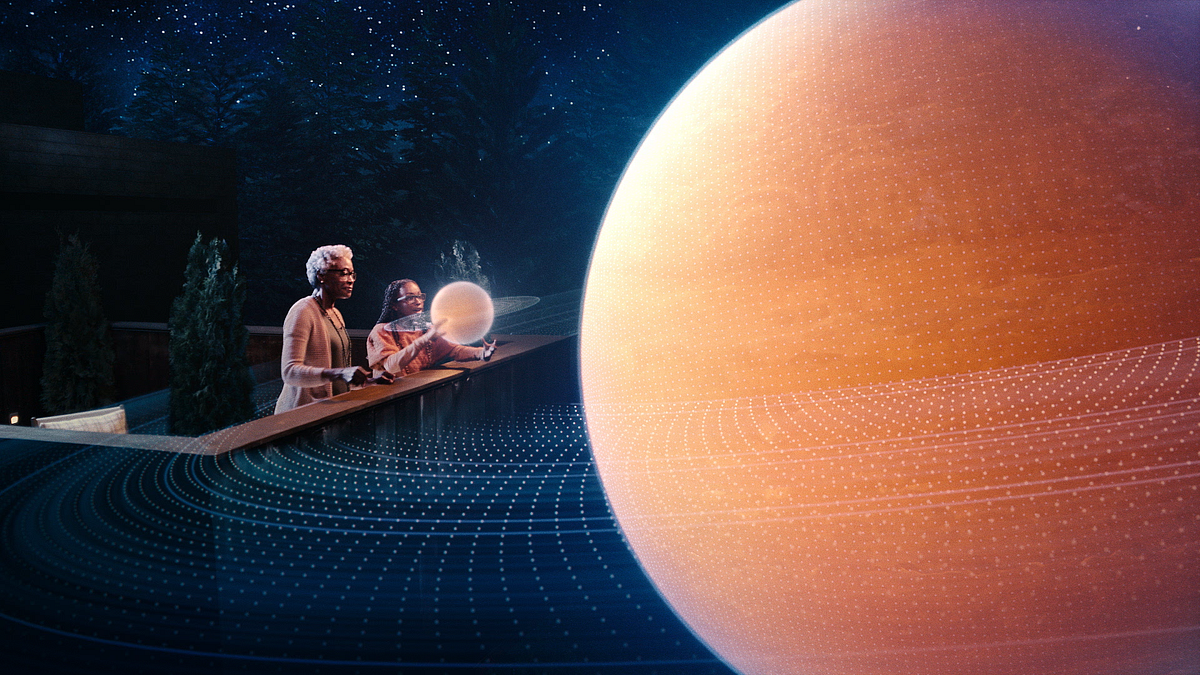 Facebook becomes Meta — Press Assets from Meta
A few weeks ago Facebook announced the change of its group name — not the platform itself — to META. This new name refers to the developing technology of Metaverses, the virtual worlds.
The fact that Facebook, one of the big groups leading the world of technology, adopts such a name shows their position on this technology. It seems obvious to Mark Zuckerberg and his team that the metaverse is the technology that will drive the future of humanity.
This name change has created a real craze for the metaverse. Decentraland, a virtual world project based on blockchain technology, has seen the price of its token — MANA — increase by 435% in a few weeks.
The wave of curiosity towards this new or future technology has also brought its share of philosophical questions. Many people fear a world that is even more virtual than it already is. This questioning is, without a doubt, legitimate, and it would not be healthy not to question the arrival of such a disruptive technology.
However, before tackling the philosophical question behind the metaverse, it seems important to understand it well. What is the purpose of this technology? Where are we technologically speaking? In a more general way, what are these metaverses?
Virtual world, or Metaverse
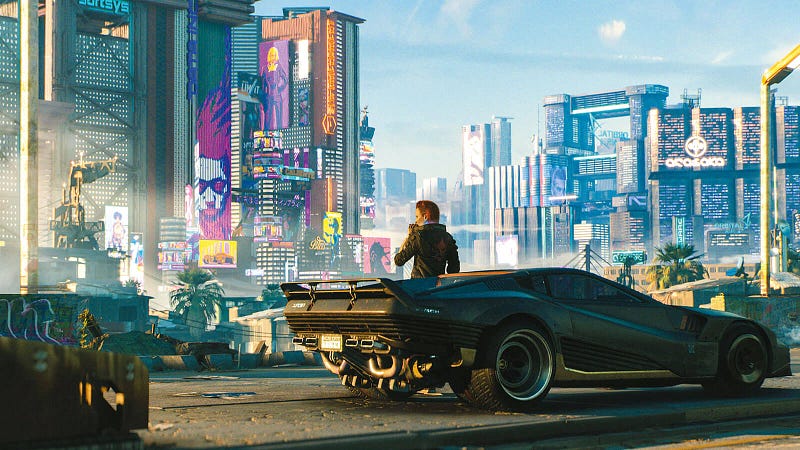 Image of the video game Cyberpunk 2077
A metaverse is a fictional virtual world. Contraction of the English words meta and universe, the word metaverse appears for the first time in Neal Stephenson’s novel: Snow Crash. This science-fiction novel was published in 1992, and features a “post-cyberpunk” America — i.e. developed around future technology — in which we follow a hacker and two acolytes in their fight against a magnate controlling the human mind. In this novel, the metaverse is omnipresent as a tool for accessing unlimited knowledge in the guise of today’s web.
From a purely etymological point of view, the word meta comes from Greek and means “after”, “beyond”. The word universe is defined as follows: “The whole of all that exists, the totality of beings and things”. We understand that the metaverse is the incarnation of the evolution potentially to come of our universe, “the universe after”.
A metaverse is thus a virtual universe which would not be long in coming. In this world, we could explore, learn, exchange, create, etc. Everything we are able to do in our current universe, but also and especially much more, since this new universe would be virtual and thus controlled by man.
We could therefore be led to collect dragons’ eggs, or even dragons themselves. You want to climb Everest in a bathing suit? Why not? Well, Everest… It will finally be only a small hill next to what we will be able to create. Humans would become the creator of their own universe, and not just an observer. Everything that man is capable of imagining would finally be achievable.
Although the word metaverse appeared in 1992 with Stephenson’s novel, the idea of a virtual world has existed in pop culture for much longer. We find this “utopia” in many movies (Tron, Matrix…), novels (Simulacron 3)…
 Sword Art Online poster
The Asian culture in particular, through manga or Webtoon (comics with a reading format adapted to smartphones), has capitalized enormously on this idea of metaverse over the last 10 years. The number of works, featuring a world where headsets or capsules would allow us to “connect” to a virtual fantasy or science fiction world, is exploding. Among the most popular, is published in 2012: Sword Art Online. This Japanese light novel by Reki Kawahara projects us into a world where a helmet, the NerveGear, allows humans to be completely projected into a virtual fantasy world SAO — or Sword Art Online. In this world, we fight monsters, we carry out quests, we live an adventure in the manner of a video game, except that here, everything is transcribed: touch, smell, etc.; all the senses are recreated, forgetting that we are in a fictional world.
The metaverse is thus a technology of fictional virtual world which would make the man master of his universe, which would be only a piece of code in the end. One could be fully or partially immersed in it with the help of technologies allowing a perfect human-machine interface.
A complete or partial immersion
While waiting to be able to interconnect humans and machines, more “basic” metaverses are already being implemented. These offer a less complete but equally interesting immersion. Two metaverse trends stand out.
Virtual worlds totally dissociated from reality, or Virtual Reality
There are virtual worlds to which we connect through applications or virtual reality headsets. These are totally virtual worlds. We “leave” our condition of human being and our universe to project ourselves in a different universe.
For example the VR (virtual reality) Oculus headsets, belonging to Facebook — Meta now. These headsets, developed since 2012, allow us to place ourselves visually in a virtual world. We find ourselves in the center of Resident Evil or Star Wars games, hunting zombies or troopers of the Empire. The immersion is still partial, we only isolate our vision, and the movements are possible thanks to hand-held controllers.
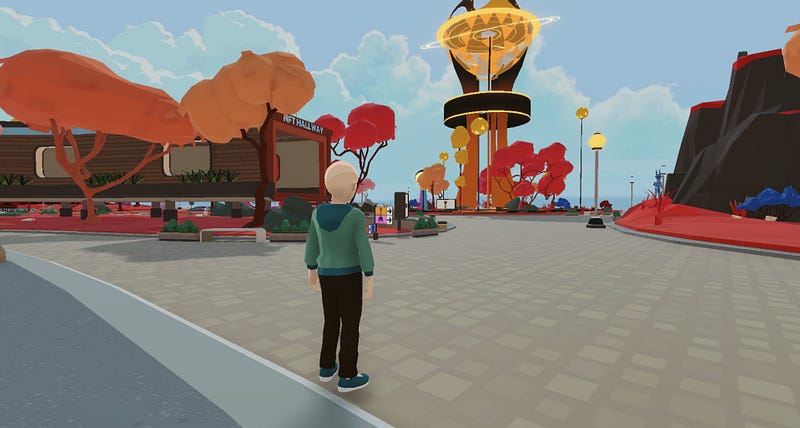 Screenshot of the Decentraland world
With less immersion, but still virtual worlds, there is worlds that are accessed through websites or mobile applications, such as Decentraland. Decentraland is a virtual world built on the Ethereum blockchain that offers its users 90,601 plots of — virtual — “land” to buy, on which you can build, walk around, come and exchange goods… Like in the real world, but online, and with much more “freedom”, because it remains a virtual world, simply coded. Our senses are not immersed, but we find ourselves in a virtual world where many interactions are possible.
The improvement of the “real” world, or Augmented Reality
The metaverse can also be seen as an enhancer of the real world. We try to improve our perception of the world. It is augmented reality more than virtual. Adobe for example follows more this positioning.
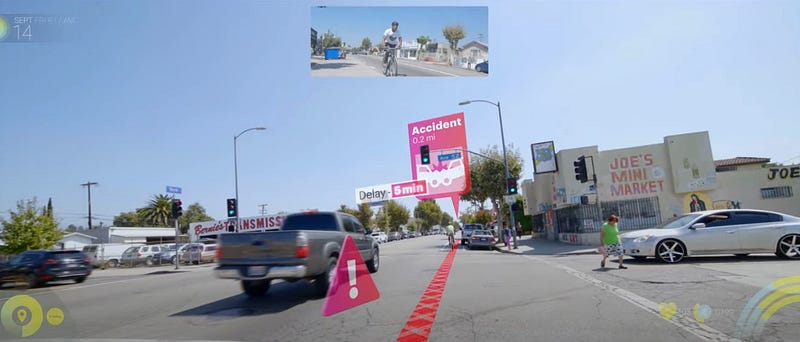 Augmented reality and metaverse — from Adobe Max 2019
The idea is to integrate, or superimpose, a virtual world to ours. For this, we can, for example, use smart glasses with a screen, like Google Glass. We could then “see” our way directly with the integration of a GPS directly in our retina, or make a call without needing a smartphone, but just thinking of calling someone.
The idea is to stay “on earth” but to improve our perception of our surrounding.
The idea of metaverse is therefore that of vast virtual worlds, and seems to interest more and more investors, Google, Facebook, Adobe. The question is now to define the usage of such a technology. What could it do for us? Why would it be useful?
I tried to address this question in an other article, The different Uses of Metaverse.
Here is a bunch of interesting link on Metaverse:
- Adobe MAX 2019: Adobe Aero | Adobe Creative Cloud — YouTube
- The Metaverse and How We’ll Build It Together — Connect 2021 — YouTube
- Nvidia’s Jensen Huang reveals vision for the Metaverse! (with Omniverse) — YouTube
- Metaverse — Wikipedia
- Mark Zuckerberg is betting Facebook’s future on the metaverse — The Verge
- Escaping the Gilded Cage: User Created Content and Building the Metaverse Institute for Information Law and Policy Symposium: State of Play: II. Article 49 New York Law School Law Review 2004–2005 (heinonline.org)
- 3D Virtual worlds and the metaverse: Current status and future possibilities: ACM Computing Surveys: Vol 45, No 3
- Welcome to Decentraland