Innovation for sustainable viticulture, Vitibot
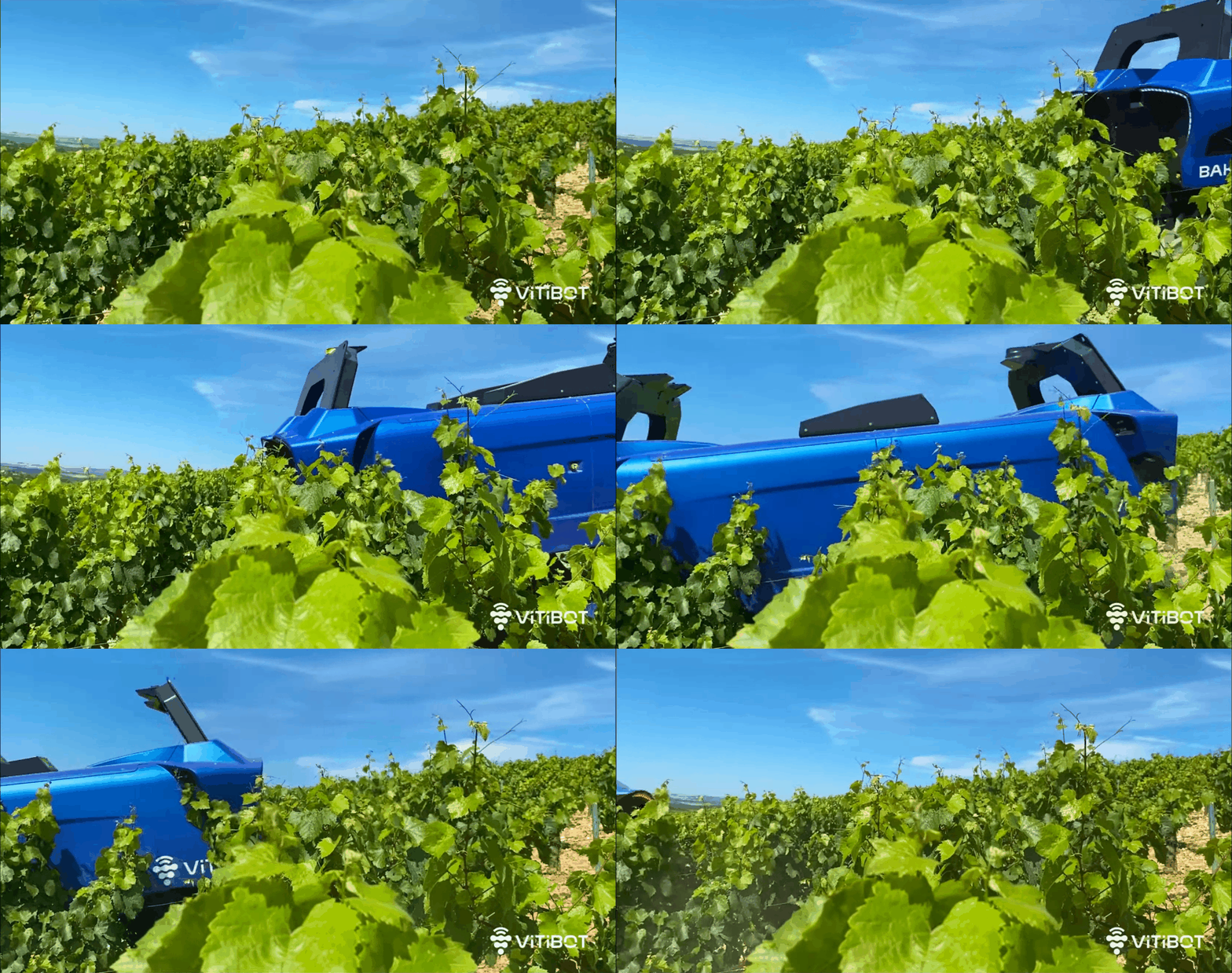
VitiBot is a French industrial company founded in 2015 by young engineers who are passionate about robotics and which now has about fifty employees. This startup from Reims manufactures electric vineyard straddlers with the vocation to work in complete autonomy. In addition to their straddle carriers, Vitibot offers a range of services to assist winegrowers in managing their vineyards.
The technology
VitiBot offers two different wine robots for sale, the Bakus-P60S (“small” model, 2m high) and the Bakus-P60L (larger model, 2m50). For those who are passionate about history, we will note the reference to Bacchus, the Roman god of inebriation.
Rather than building single-task robots, Vitibot has chosen to propose modular robots with more than ten different tools. It is this plurality of tools and functionalities that differentiates it from its competitors. In fact, like the other players in the field of wine-making robotics, the Reims-based company offers tools for working the soil as well as more precise spraying and topping tools. The spraying (of fertilizers or pesticides) also has the particularity of being done in a totally confined environment, with the objective of recovering more than 80% of the emissions of the products, which usually end up in nature.
Bakus are designed to be energetically responsible (to be modulated according to the energy production of the country of use) with a 100% electric consumption, thanks to lithium batteries. On the user’s side (winegrowers), Vitibot attaches great importance to the ease of use of these products. The robots are totally autonomous with precision, in the order of a centimeter, achieved through the use of 2 RTK GPS. The Bakus is also quick to use. Vitibot assures a preparation time of the machine (assembly of the various tools) lower than 20 minutes.
In addition to offering innovative products, Vitibot also offers support services for the development of sustainable viticulture. Among these services are the review of the compliance of the domain, financial assistance, mapping, and training of users.
The new technologies, still in the testing phase, should also be available in 2023 as finished products.
Fundraising
After the first fundraising of 3 million Euros in 2018, which has allowed the evolution of its Bakus robot towards a marketable version, Vitibot closed a round of financing at 11 million Euros in November 2020. This round of financing was an opportunity to renew the support of its historical partners, the majority of which are wine professionals, including Roederer, Martell Mumm Perrier-Jouët (Pernod Ricard group), Champagne Laurent-Perrier, Piper, and Charles Heidsieck (EPI group).
The BPI is also on the list of VitiBot’s historical supporters.
Accompaniment
Vitibot is supported by BPI France, ADEME (Agency for Ecological Transition), Green Tech Verte (Ministry of Ecological and Solidarity Transitions), IAR (Bioeconomy Cluster) and ID4CAR
Business Model
It is difficult to find information about the business model and the price of the solutions proposed by Vitibot.
A priori, Vitibot remunerate itself, on the one hand, thanks to the sale of their straddle carriers (around 150.000–175.000€), which can also be rented, and on the other hand through an annual subscription for the beacons 4.800€ HT/annual the robot, and the grass cutter (electric obviously).
Vitibot claims that the use of their machines “divides your operating costs in the vineyards by at least 2 compared to the use of a conventional tractor”.
As for the other services offered by Vitibot, such as compliance review of the domain, financing, mapping, or user training, it is difficult to know the rates applied.
Customers / Partners
Bakus, Vitibot’s straddle carrier, is already roaming the vineyards of Burgundy, Charentes, Champagne, Garonne, Pays de Loire, Provence but also Italy, Switzerland, Spain, and the United States.
Among its clients, we find domains such as Château Haut-Bailly, Château de Mont-Redon, Vignes de la montagne Sainte-Victoire, Maison Martell, Domaine Louis Moreau and many others.
Vitibot also does regular demonstrations on great wine estates such as Château de Santenay, the house M. Chapoutier or Château de Boursault.
Market
In France, in 2021, 40,728 tractors were registered for the first time, all families included. If we focus on high-clearance tractors, the figure rises to 391 tractors, which represents a marked increase of 16%, which has yet to catch up with the record of 721 machines established in 2019.
According to Vitibot, the current global wine tractor market is worth €1.5 billion per year.
Competitors
As we have seen previously, the straddle tractor market has many players. However, most of these players offer more varied products than Vitibot and do not focus only on vineyard straddlers.
The market is dominated by :
As for the other players, we find:
However, it should be noted that a small proportion of the straddle tractors on the market operate electrically, such as Bakus, and there are few, if any, young companies specializing in vineyards.
The business part of this article was written by Emilie Nouacer, the tech part by Mathieu Van de catsije.