Foods of the future, and future of food
Contents
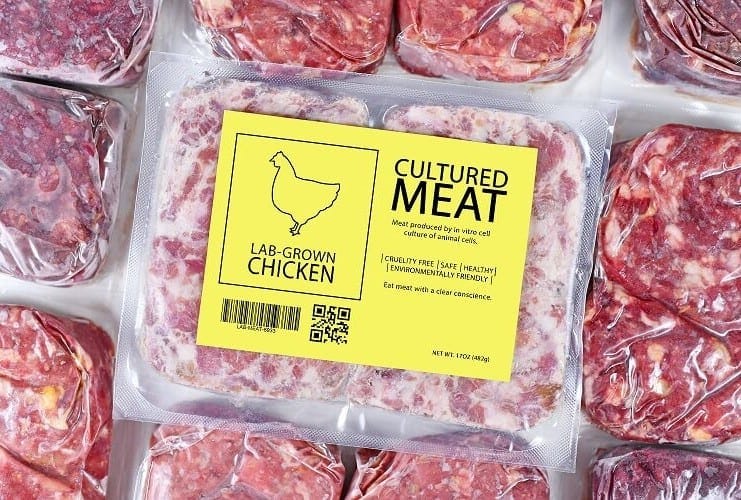 Photo of Cultured meat via Vegconomist
17, it’s about adulthood, the last year of high school, but it’s also the share of food production in the world’s carbon footprint, 17%.
Meat production has doubled in 30 years, and quadrupled in 60, bringing us to an average of 350 million tons consumed per year. The same is true for fish, whose production has quadrupled in the last 50 years, bringing us to nearly 200 million tons per year in 2015. In addition, the production of sugar cane (1.8billions of tons per year), cereals, potatoes … All this accumulates to 6 billion tons of CO2 equivalent per year.
The gravity of the situation is unquestionable, and, fortunately, more and more highlighted in the media. The number of humans does not seem to stop increasing, and the majority of the living do not seem ready to radically change their diet. Fortunately for us, many companies offering laboratory meat or innovative production methods are emerging. Which company will save us from this crisis already well underway?
“AgriTech “ in full swing
At the end of 2021, there were nearly 254 “AgriTech” start-ups in France — i.e. companies dealing with issues related to agriculture. The fields are varied, urban agriculture, biotech, agricultural production equipment, collection and analysis of data related to agriculture … All have one goal in mind, to improve the way we produce or consume. In 2020, more than 22 billion dollars were invested in agricultural start-ups, a figure that has increased significantly over the last ten years.
The start-ups proposing the food industry are flourishing, and bring with them many innovative solutions to current problems. With surprising products, to say the least, many start-ups have gained strong notoriety among the media and the general public. In December 2020, for example, Singapore was the first country to approve the lab-grown meat created by Eat Just, under the brand GOOD Meat. Other, more exotic products, such as crickets or larvae, are gradually making their appearance in Western stores.
New (albeit) production methods
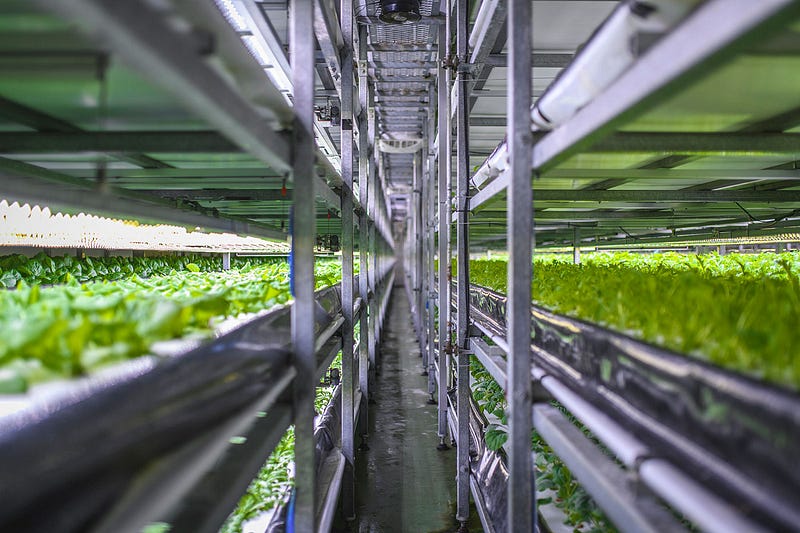 Photography of a vertical farm from the company Nordic Harvest
Among the innovations proposed are “new” production methods such as aquaponics, hydroponics, or the famous permaculture. Although they may seem innovative and current, most of them are not new. Aquaponics, for example, was invented by the Aztecs over 3,000 years ago. More than “new”, these methods are mostly brought back to the forefront and considered as a perennial solution to the climate crisis. However, as exciting as they are, they are not yet implemented, mainly because of the costs they generate.
New and expensive
Different from the systems that have been in place for decades, these contemporary methods have a hard time gaining acceptance. The infrastructure and maintenance costs are still too high compared to the average farming system. While with current methods the cost of producing a kilogram of potato is around 20 cents, the cost of the same kilogram produced in an aquaponic farm would be closer to $3. Working in a rather particular way, these systems are often more fragile and only work with certain types of plants.
Not so ecological
From an ecological point of view, although these methods often seem to be promoted as green and responsible, the reality is different. Indeed, requiring controlled environments, these methods are often very expensive in energy. In the case of vertical farms, for example, while one kilogram of strawberries produced conventionally requires 0.46 kWh of electricity per squared meter per year, a vertical farm requires 1404 kWh/m²/year, or 3,000% more energy. The environmental impact of such farms is therefore strongly linked to the energy production methods. In a country like France (mainly powered by decarbonized energy), the carbon footprint of a vertical farm would be low. Conversely, the implementation of such farms in a country like the United States (producing 60% of its electricity with fossil fuels), the result would be quite different. It is important to note, however, that a proper comparison is still complicated. Indeed, vertical farms are still under development, and more often used for research purposes than for real food production.
Rethinking food
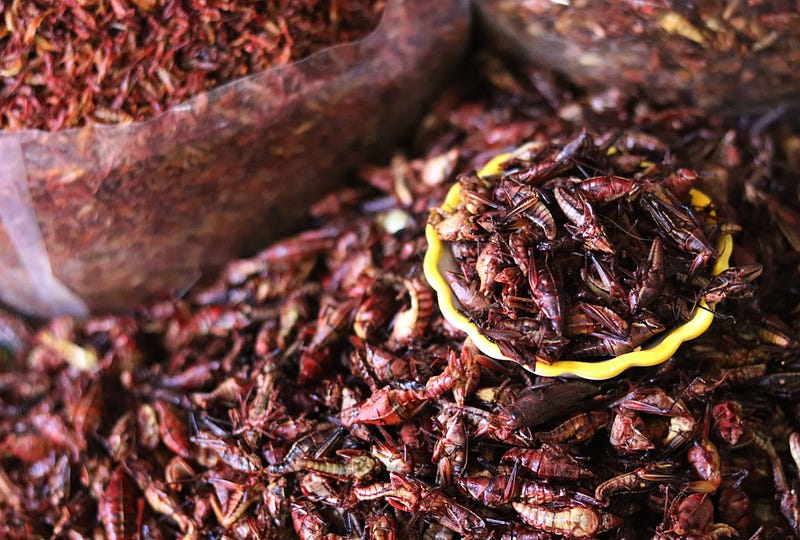 Photo by analuisa gamboa on Unsplash
Another way to rethink agriculture is to rethink the food itself. In France, meat consumption is approximately 85 kg per person per year, yet it is extremely polluting. For beef, for example, 1 kg is equivalent to 27 kg of greenhouse gases. Meat is a complete way to eat quickly and well, but nothing forces us to make it our main food. Many companies are working to change the food market towards more ecological diets. Whether it is through veganism, insect feeding, called entomophagy, or more recently the creation of in vitro meat, there are many ideas.
Entomophagy, or eating insect, strange but better
Emerging on the Western market, entomophagy is not a new practice. In Asia, Africa, and Latin America, eating insects is a common practice. Already in ancient times, the Greeks and the Romans used to eat insects. Often perceived as disgusting, associated with filth, insects are nevertheless considered as a sustainable and responsible source of protein for our diet. The yield of insect production is often more prolific than that of conventional meat. The edible percentage of a cricket, for example, approaches 80% while beef is closer to 40%. However, one must be careful with the costs, which are often higher than the average, notably due to the still niche aspect of the market in Europe. Insect meal (used for animal feed), for example, is sold between 1,500 and 1,800 euros per ton against 1,000 to 1,200 euros per ton for fish meal. However, the environmental impact is not negligible. While one kilogram of mass gain is equivalent to 2,800 g of CO2 equivalent for beef, the Kenyan Margined Ketonia, which is an African species of beetle insect, produces only 121 g per kg. Cricket has the record of the least CO2 emitting insect, with an average of 1.57 g emitted per kilogram of mass gained. There remains the problem of the image that insects have in Western culture. This problem occupies many start-ups, which try to make insects that many find repulsive more appetizing. As a result, there are now lollipops, cakes, drinks, and other everyday foods, all made from insects.
A newer and less accessible diet, in vitro, or lab-grown meat.
The first burger made from a lab-grown steak was enjoyed at a London restaurant in 2013. This artificial meat came from a cluster of muscle cells that multiply in Petri dishes containing a rich culture medium. The company behind this feat, Eat Just, did not stop there. Indeed, while it is already known for producing plant-based eggs, a few years later the company presents in vitro nuggets. But if you want to have the opportunity to taste this meat of the future, you will have to put your hand in the wallet, these nuggets costing close to $50 a unit. The problem with in vitro meat is indeed the cost. The means necessary for the production of such meat are not small. There is no in vitro meat factory yet, but a hypothetical factory of this new meat would not be much cheaper than a traditional slaughterhouse, yet it would produce much less meat. However, one can imagine that with time the production cost of such products will decrease. At the beginning of 2021, the Dutch start-up Mosa Meat indicated — without giving a clear price — that it had succeeded in reducing the production cost of fat by 65x. Mostly, however, although they benefit from strong media coverage, companies producing in vitro meat encounter many problems due to the cost of their products, but also to the legislation of countries that is not yet adapted to such products. All this leads many of these start-ups to fail in their insertion on the market. From an ecological point of view, there again these companies encounter a problem. Indeed, although all this solves the problem of animal abuse, developing cells in the laboratory has a very high energy cost. The production of chicken in vitro would be for the moment 3 times more energy consuming than conventional production. Still, this new industry seems to persist, and it is quite possible to hope that the costs and the energetic necessity will be reduced as the industry advances.
Other artificial meats are emerging. We are talking about 3D-printed meats, thanks to bio-printing. Some companies also propose meats made from plants, such as soy. And let’s not forget the rise of vegetarianism, which commits us to simply replace meat with other foods. The diets of tomorrow are numerous, and it is up to us to make sure that they are as responsible as they say they are.
A future taking shape, but still unclear
Whether it is by modifying our production methods or the products we consume, the future of food still seems rather vague. There are certainly many innovative and exciting solutions, but, for the moment, few seem to stand out and have a positive impact both economically and ecologically. However, we can still hope for an evolution in the right direction — that of ecology — in the years to come.
Also, the current observations must be put into perspective by remembering that we are comparing the results of a well-established and optimized industry with those of newly created and not yet industrialized companies. Some products, such as insects, will also require a change in mentality, which is difficult but far from impossible. What do you think about it?
Here are some links you may find useful if you want to dig deeper into the subject:
- How an Indoor Farm Uses Technology to Grow 80,000 Pounds of Produce per Week — Dan Does — YouTube
- Vertical farms could take over the world | Hard Reset by Freethink — YouTube
- Solar Panels Plus Farming? Agrivoltaics Explained — YouTube
- 3D-printed fake meat: The healthier, greener future of food? — YouTube
- The Futuristic Farms That Will Feed the World | Freethink | Future of Food — YouTube
- What’s the future of food? | The Economist — YouTube