Facilitate WEB accessibility, FACIL'Iti
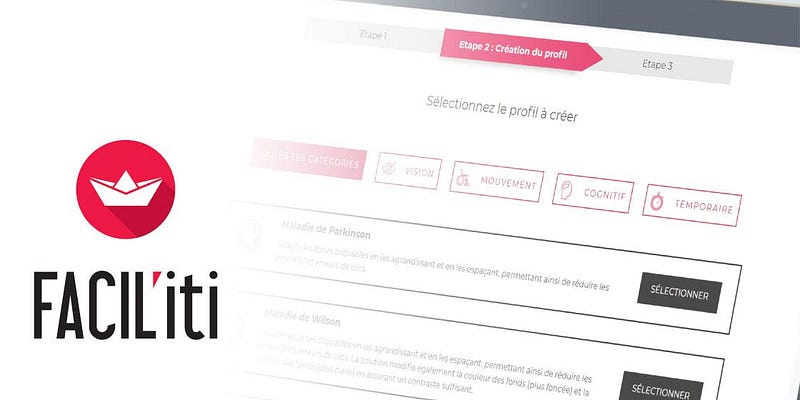 Facil’iti image from Hauts de Seine Habitat
FACIL’iti is a company originating from Limoges founded in 2018 and gathering 21 employees. This startup aims to facilitate digital accessibility by adapting the display of websites according to the visual, motor and cognitive needs of the reader.
You just have to create your profile (for free) by choosing customization options and each site equipped with FACIL’iti will then automatically adapt to your needs.
Since an example is better than a long speech, here is an example of application: You have Parkinson’s disease; You fill in your profile on FACILI’iti by checking the box “Parkinson’s disease” and “Blue light” to facilitate my visual comfort; FACIL’iti will then enlarge the space between the clickable zones and modify the colors of the site to facilitate your navigation; You go on the site of La Redoute, equipped with the FACIL’iti device, the site will be displayed as follows:
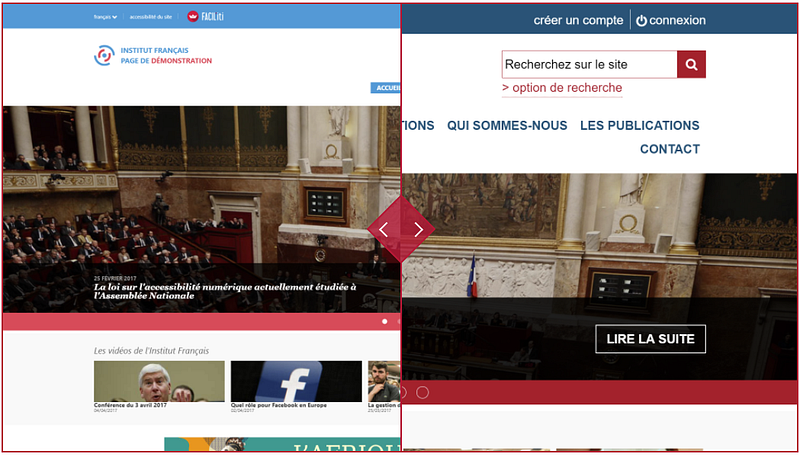 Before and after view from Facil’iti website
FACIL’iti proposes today more than ten options going from visual fatigue to visual impairment through multiple sclerosis or dyslexia. You can check several boxes if your needs are multiple and you can adapt the general aspect of the site (font, spacing of the words,…) for more comfort.
Technology
In terms of technology, this French startup seems to have nothing to envy to anyone. The project, launched by the communications company Iti in 2015, has been racking up awards. The startup, ranked 3rd worldwide innovation in the “services” category at CES 2016, has received 23 awards from the world of digital, disability, silver economy, e-commerce and CSR.
But what does the startup actually offer? FACIL’iti promises to adapt the web to different disabilities such as Parkinson’s disease, dyslexia, or visual diseases such as color blindness. For this, the startup works on the simple adaptation of the source code of the visited pages: fonts used, font size, colors, sizes of the click zones, etc. More than a total renewal, FACIL’iti allows its customers to keep their original site (compatible with “99%” of internet, intranet and webapp sites) and comes to install in ten minutes a simple overlay. After that, it only takes a few clicks in a drop-down menu to select the adaptations you want to make. And thanks to the use of (famous) cookies: no need to reconfigure the thing on each website, the adaptation is done automatically.
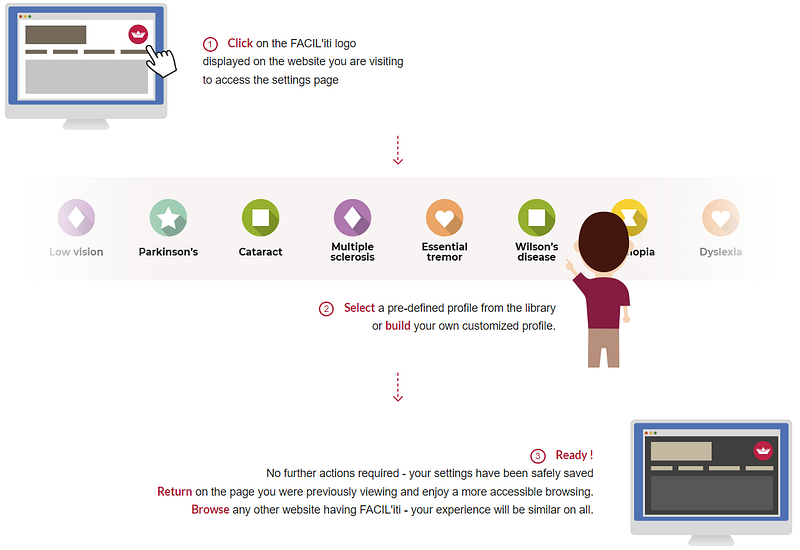 How does it works ?
The notion of WEB accessibility has already been in fashion for several years, and FACIL’iti does not really reinvent the wheel but rather offers a thoughtful service (after 5 years of R&D with reference disability associations: UNADEV, APF, France Parkinson…) taking into account the disabilities of everyone. With its drop-down menu, the company offers a greater level of customization than most existing solutions. When many sites are content to increase the font size or change some colors, FACIL’iti pushes things a little further by really thinking about each situation and each person.
For some time now, the startup has been receiving some criticism from other entrepreneurs, who accuse it of being primarily a marketing company and of not really making the web more accessible. Is this true? We don’t have the necessary knowledge to judge effectively the effective contribution of their technology but what is sure is that given the state of web accessibility described by the American organization WEBAim, a few more people working on a solution helping the common people are not to be refused.
For the future? The company currently seems to be working on an adaptation for people with autism spectrum disorders who would express reading difficulties.
Accompaniment
FACIL’iti joined Station F in 2018 and joined the incubators of Showroomprivé and LVMH in 2020. The startup is no longer part of these support organizations and it seems that it has not yet diluted its capital.
Business Model
FACIL’iti is paying for the editors and free for the users. The FACIL’iti price list includes installation fees as well as a monthly subscription for site owners. The subscription starts from 350 euros per month, with an installation cost of 2000 euros.
Clients / Partners
FACIL’iti has already been adopted by more than 500 websites including for example La Fnac, Michelin, MAAF, Allianz, BPI France, Kenzo, Kiabi, My TF1, Veepee and many others which gather 950 000 users. The company continues to expand internationally and is already present in France, Asia and North America.
Market
Almost all of us use the Internet today and there are many people who need to adapt their environment. According to the World Health Organization, 15% of the world’s population has a visual, motor or cognitive disability and has difficulty reading, understanding or accessing content published online. According to the WHO, these numbers are increasing worldwide as the population ages.
Moreover, digital accessibility is now a requirement for all public websites in accordance with the law of February 11, 2005 for equal rights and opportunities, participation and citizenship of disabled people.
The actors concerned by this legislation are :
- Public services
- Organizations delegating a public service mission
- Organizations providing a service to the public
- Organizations dedicated to the disabled
- Companies whose turnover exceeds the €250 million threshold.
Non-compliance with the law on accessibility leads to a penalty capped at 20,000€ renewed every year.
The market is therefore huge since the majority of websites are still not accessible to all.
Competitors
Since the accessibility of websites has become a mandatory feature for multiple organizations, many actors have developed on the subject of digital inclusion. However in the lot, we find few French companies:
- AccessiBe (2018- Tel Aviv)
- AudioEye (2005 — Arizona)
- EqualWeb (2014 — Israel)
- Confort+ (Orange) — Free extension
There are also consulting firms or web developers like AccessF1RST (2015 — France).
The business part of this article was written by Emilie Nouacer, the tech part by Mathieu Van de catsije.