Digital sobriety within information systems
 Photo by Marvin Meyer on Unsplash
This article aims to summarize the result of a market study elaborated by the Master in Innovation Management of the PSL University. The study was conducted in October 2021. The goal was to understand the position of corporate and especially CIO on the importance of having a better control on our usage of digital (digital sobriety).
Study and context
Between 2013 and 2019, the share of greenhouse gas emissions from digital technologies almost doubled from 2.5% to 3.7%. In comparaison, the aviation industry is responsible for 2.5% of global emissions. The need to reduce these emissions and prevent future growth of these figures is the responsibility of everyone, human and corporate.
Company and their culture have lot of influences on people actions. The importance of digital sobriety in the professional environment is by no means negligible. It seems important to analyze the place of the concepts of digital sobriety and Green IT within companies and more specifically within IT departments, the heart of digital business. With these in mind the implementation of a market study makes sense.
It means moving from instinctive or even compulsive digital technology to controlled digital technology, which knows how to choose its directions: in view of the opportunities, but also in view of the risks. (The Shift Project, 2020)
To get an better picture of the situation a qualitative study consisting of semi-directive interviews on the theme of digital sobriety and Green IT was conducted with sixteen CIOs, or top IT managers. The managers interviewed are of various ages and experiences. They work in multiple sectors of activity, such as the plastics industry, banking, or aerospace. The interviews were then transcribed and analyzed in order to get a better understanding on the current status of digital sobriety within the corporate world.
Key results
This study has highlighted the central role of CIOs in the business world. Indeed, they generally see themselves as having multiple functions, the ones of manager, technician, strategist, and a key mission in the company’s decision-making process. Especially since IT and data processing are becoming increasingly important in all sectors of activity.
CIOs are often experienced people, with an average age of 43, who have already worked in a similar department or have developed relatively advanced technical skills in IT.
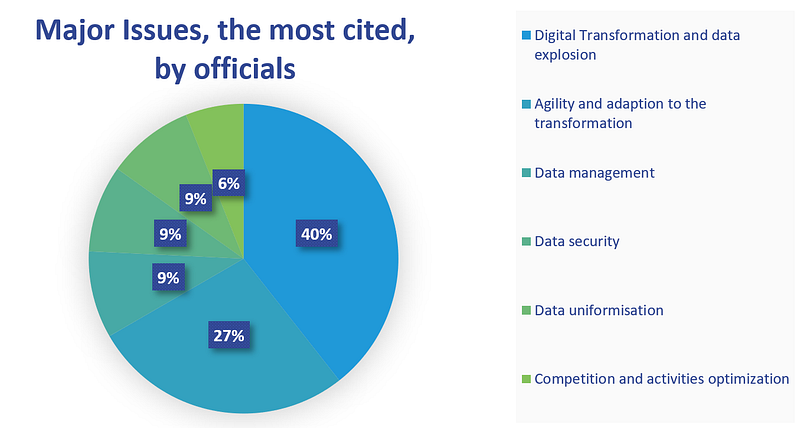
While digitalization and the explosion in the amount of digital data are identified as major challenges for the future by CIOs, the question of responsible management of this data appears to be secondary, or even ignored by a large proportion of them.
The themes mentioned to describe digital sobriety are: emails (storage, usage, quantity), the issue of data storage, and communication channels.
Ten of the interviewees showed some interest in ecology on a personal scale. Four were strongly interested in the topic, one showed interest through someone else, three others dealt with the topic through the actions of the companies they work in. And two talked about the impact on future generations.
Managers focusing on the issue of CSR and digital sobriety are present in 11 of the 16 structures interviewed.
3 companies have the issue carried by the management, 2 others by individual people, “IT” and “HSE”, 6 others by groups of volunteers registered in a project or a department.
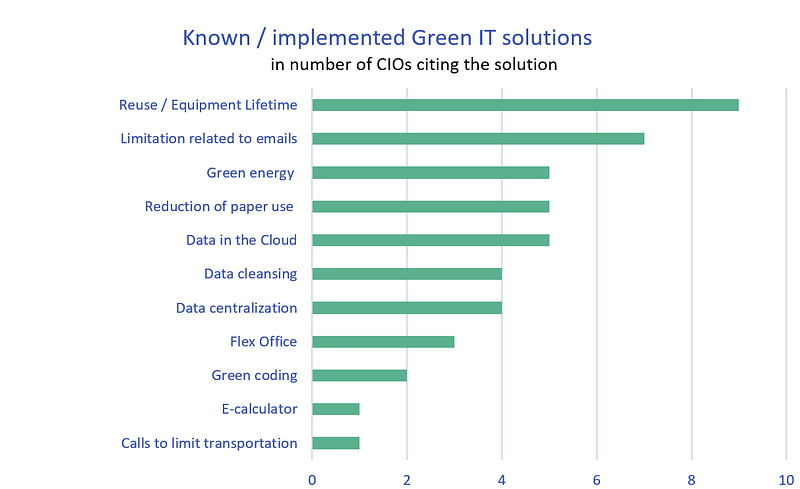
Most of the companies surveyed have already implemented Green IT solutions, or digital sobriety. The main solutions in place are: a better management of mobile or computer fleets, by increasing the life cycle duration and post-use recycling (implemented by 9 companies); an encouraged limitation of email usages (implemented by 7 companies).
Economic issues as well as the difficulty of encouraging a global change among employees were the two most cited obstacles to the deployment of Green IT solutions.
Global analysis
Most CIOs are already implementing Green IT or digital sobriety solutions, although they are sometimes unaware that it fits into these terms.
However, the solutions currently in place remain meager, and we note that they are often of surface.
The main issues for CIOs are not ecological, but rather dependent on the business. It seems therefore coherent that few resources can be fully allocated to the research and optimization of more important solutions.
In many companies, the CIO observes a certain brake on change coming from the employees themselves, who seem reluctant to change their consumption habits.
Overall, CIOs seem to be affected by current ecological issues, but for the majority, there is little evidence of drastic change on the horizon.